Piercing types: ear and face piercing guide
Piercings are named after the part of the body they go through. Knowing the names makes it much easier to ask a studio for exactly what you want, and to understand why some piercings take a few weeks to heal while others take most of a year.
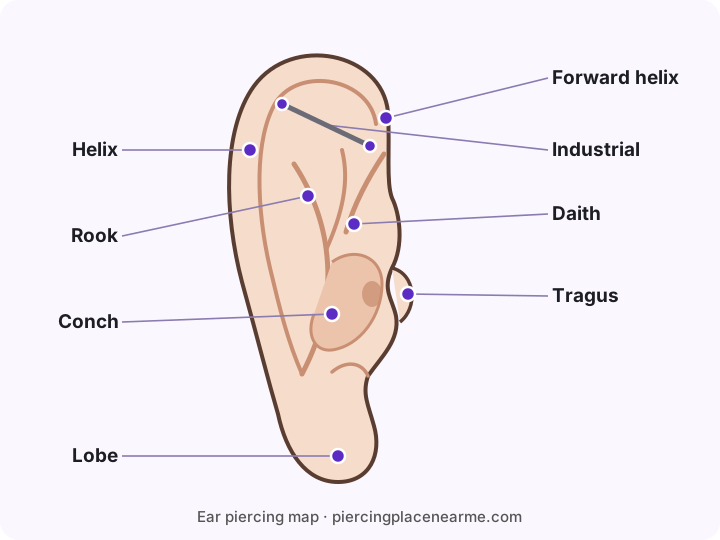
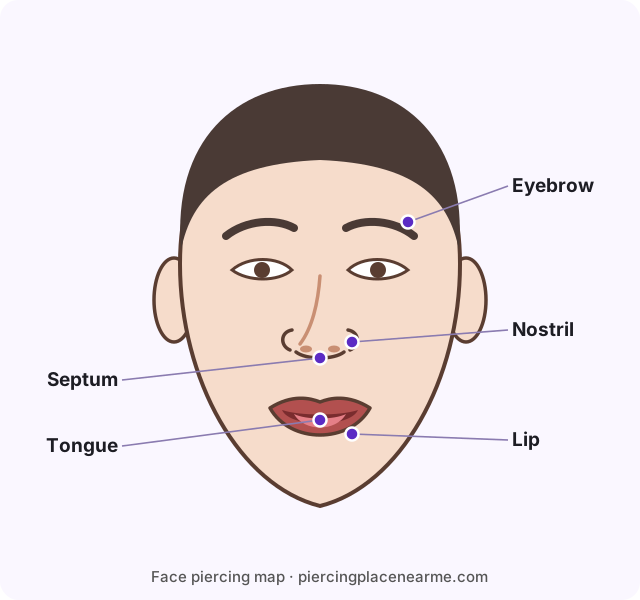
The maps below show where 13 popular piercings sit on the ear and face. Under each map you will find what each piercing is, a typical healing time and the jewelry most piercers start with. Everyone heals differently, so treat the times as a rough guide and follow the aftercare your own piercer gives you.
Ear piercing types
Lobe piercing
The soft, fleshy bottom of the ear. It has no cartilage, which makes it the classic first piercing.
- Typical healing time
- About 6 to 8 weeks, often a little longer before you change jewelry
- Starter jewelry
- Flat-back labret stud or threadless stud; rings once healed
Lobes can be stacked (first, second and third lobe) and are the easiest piercings to look after.
Helix piercing
The outer rim of cartilage that curls around the top and side of the ear.
- Typical healing time
- About 6 to 12 months
- Starter jewelry
- Flat-back labret stud to start; a ring can follow once fully healed
Cartilage heals slowly and dislikes pressure, so try not to sleep on that side while it heals.
Forward helix piercing
The front part of the rim, just above where the ear meets the face, near the tragus.
- Typical healing time
- About 6 to 12 months
- Starter jewelry
- Small flat-back labret studs
Often done as a pair or trio of small studs in a line.
Tragus piercing
The small flap of cartilage in front of the ear canal.
- Typical healing time
- About 6 to 12 months
- Starter jewelry
- Flat-back labret stud
Earbuds and phone calls can press on a fresh tragus piercing, so be gentle with it.
Daith piercing
The fold of cartilage just above the ear canal, where the rim of the ear (the helix) runs into the bowl of the ear.
- Typical healing time
- About 6 to 12 months
- Starter jewelry
- Small ring, seam ring or curved barbell
A tricky placement that needs an experienced piercer, because the needle has to pass through a tight, curved fold.
Rook piercing
The ridge of cartilage in the upper inner ear, between the inner and outer conch, running parallel to the rim.
- Typical healing time
- About 6 to 12 months, sometimes longer
- Starter jewelry
- Curved barbell
Fit depends a lot on ear shape. A good piercer will tell you if your rook ridge is pronounced enough.
Conch piercing
The bowl-shaped middle of the ear. An inner conch sits in the bowl; an outer conch sits on the flat area between the bowl and the rim.
- Typical healing time
- About 6 to 12 months
- Starter jewelry
- Flat-back labret stud; a large ring can be fitted to an outer conch once healed
One of the larger cartilage areas, so there is plenty of room for placement.
Industrial piercing
Two holes in the upper ear, usually a forward helix and a helix, joined by one straight bar.
- Typical healing time
- About 9 to 12 months or more, since it is really two cartilage piercings
- Starter jewelry
- Long straight barbell sized to your ear
Swelling in one hole affects the other, so some piercers suggest healing two separate holes before fitting the bar.
Face piercing types
Nostril piercing
The side of the nose, on the curve of the nostril.
- Typical healing time
- About 4 to 6 months, sometimes up to 9
- Starter jewelry
- Flat-back labret stud or nostril screw to start; a ring once healed
Placement is usually lined up with the crease of the nostril.
Septum piercing
The thin strip of soft tissue at the front of the nose, just in front of the cartilage, between the nostrils (not the cartilage itself).
- Typical healing time
- About 2 to 3 months
- Starter jewelry
- Circular barbell (horseshoe) or ring
A circular barbell can be flipped up inside the nose to hide it when needed.
Eyebrow piercing
A vertical surface-style piercing through the outer part of the eyebrow.
- Typical healing time
- About 2 to 3 months
- Starter jewelry
- Curved barbell
Because it sits close to the surface, an eyebrow piercing can migrate or reject over time.
Lip piercing
Usually below the bottom lip (a labret) or at the side of the lip; there are several named variations.
- Typical healing time
- About 2 to 3 months
- Starter jewelry
- Flat-back labret stud, with a longer post at first to allow for swelling
Ask your piercer about downsizing the post once swelling goes down, to protect your teeth and gums.
Tongue piercing
A vertical piercing through the middle of the tongue.
- Typical healing time
- About 4 to 6 weeks for the first stage
- Starter jewelry
- Straight barbell, starting long and swapped for a shorter one once swelling settles
Expect noticeable swelling for the first few days. Downsizing the bar and choosing small balls helps protect teeth and gums.
Healing time and jewelry at a glance
| Piercing | Area | Typical healing time | Starter jewelry |
|---|---|---|---|
| Lobe | Ear | About 6 to 8 weeks, often a little longer before you change jewelry | Flat-back labret stud or threadless stud; rings once healed |
| Helix | Ear | About 6 to 12 months | Flat-back labret stud to start; a ring can follow once fully healed |
| Forward helix | Ear | About 6 to 12 months | Small flat-back labret studs |
| Tragus | Ear | About 6 to 12 months | Flat-back labret stud |
| Daith | Ear | About 6 to 12 months | Small ring, seam ring or curved barbell |
| Rook | Ear | About 6 to 12 months, sometimes longer | Curved barbell |
| Conch | Ear | About 6 to 12 months | Flat-back labret stud; a large ring can be fitted to an outer conch once healed |
| Industrial | Ear | About 9 to 12 months or more, since it is really two cartilage piercings | Long straight barbell sized to your ear |
| Nostril | Face | About 4 to 6 months, sometimes up to 9 | Flat-back labret stud or nostril screw to start; a ring once healed |
| Septum | Face | About 2 to 3 months | Circular barbell (horseshoe) or ring |
| Eyebrow | Face | About 2 to 3 months | Curved barbell |
| Lip | Face | About 2 to 3 months | Flat-back labret stud, with a longer post at first to allow for swelling |
| Tongue | Face | About 4 to 6 weeks for the first stage | Straight barbell, starting long and swapped for a shorter one once swelling settles |
Aftercare basics
- Clean the piercing with sterile saline wound wash, usually once or twice a day, and let it dry.
- Leave the jewelry alone: no twisting or turning, and wash your hands before touching it.
- Avoid pressure on new cartilage piercings, including sleeping on them, tight hats and earbuds.
- Keep fresh piercings out of pools, hot tubs, lakes and the sea until healed.
- Go back to your piercer to downsize jewelry once the first swelling goes down, especially for cartilage, lip and tongue piercings.
- Redness, heat, spreading pain, fever or yellow-green discharge can mean infection. See a doctor, and do not take the jewelry out unless they tell you to.
Choosing a piercer
Look for a clean studio with an autoclave and single-use needles (not a piercing gun for body piercings), implant-grade jewelry such as ASTM F136 titanium, a clear aftercare plan and a piercer who is happy to answer questions. Many experienced piercers belong to the Association of Professional Piercers (APP). Body and cartilage piercings should be done with a sterile, single-use needle rather than a piercing gun. Rules for minors vary by state, so ask the studio what ID or parental consent it needs. Browse piercing shops by state or use the button below to find studios near you.
Uses your browser location once. It is never sent to us.
Map © OpenStreetMap contributors.
Frequently asked questions
Which ear piercing hurts the least?
Most people find the lobe the least painful, because it is soft tissue with no cartilage. Cartilage piercings such as the helix, tragus, daith, rook and conch usually feel sharper and take longer to heal.
How long do cartilage piercings take to heal?
Typically around 6 to 12 months, and an industrial can take longer because it is two cartilage piercings joined by one bar. Lobe piercings usually take about 6 to 8 weeks.
What jewelry is best for a new piercing?
Implant-grade titanium (ASTM F136), niobium or solid 14k or 18k gold. Flat-back studs are common for ear and nostril piercings because they sit comfortably while you heal.
What is the difference between a daith and a rook?
Both are in the inner ear. A daith goes through the fold just above the ear canal and usually holds a small ring. A rook goes vertically through the ridge higher up in the ear and usually holds a curved barbell.
Can I get several piercings at once?
Often, yes, but many piercers suggest limiting how many cartilage piercings you heal at the same time, and avoiding piercings on both ears if you need to sleep on one side.
Illustrations are original drawings made for this site. This guide is general information, not medical advice.